teacher appreciation

Teacher Appreciation Week: Thank You to All Who Change Lives

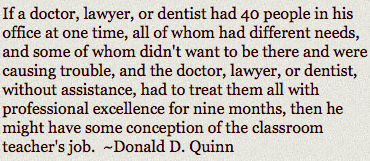
On this teacher appreciation week, let’s remind those special people in our children’s lives we truly appreciated for all you do. The lives you change and steer toward a better future. It is because of the hard work teachers put forth that scientists, artists, and all other professions have such successful individuals. Thank you for all you do!


teacher appreciation


Here’s some crafty ideas to show your teacher appreciation:

  • Garden Pack: with “a teacher’s a gardener and this is so you’ll know we truly are grateful for helping ____ grow”
  • Starbucks gift card: with “Thanks a LATTE”
  • Burt’s Bee gift pack: with “Thanks for BEE-lieving in _____”
  • Jamba Juice gift card: with “Thanks for sparking my creative JUICES”
  • Flowers: with “Thanks for helping ____ bloom”
  • Summer Survival kit: think pools and beaches
  • Lotions and such: with “You are a god SCENT”
  • Think creatively and remember the good teachers probably aren’t really money grubbers, they’d rather something have something thoughtful…why else would of they become teachers
  • 😉
behavior plan emtional disabilities

Challenges of Those with an Emotional Disability

There are many issues that arise while working with children an emotional disability, but these children are a part of the classroom and our lives, so it is important to come up with a plan for success. Children with an emotional disability are individuals like all children, so each child will be different and should be treated as such. It is important to evaluate the individual child and come up with the best game plan.

Some issues to look for can be:

  • impulsive behaviors
  • irrational decision making
  • poor social skills
  • blurting out inappropriate comments
  • lack of attention in children with emotional and behavioral disorders.
  • not easily being able to transition from one activity to another
  • yelling instead of talking
  • use of inappropriate language like swear words
  • unable to sit still can often be found in children with emotional and behavioral disorders
  • staying on task
  • rude/crude behaviors and actions toward others and themselves
  • tunnel vision fixation

behavior plan emtional disabilities

In order to help these children succeed, try:

  • Use of good multidisciplinary techniques can get help children overcome these behaviors
  • have children work with their peers to come up with a game plan and hear new ideas
  • behavior point system with reward
  • time out room if needed
  • constant praise to reinforce good behavior
  • make goals minimal so they can feel success
  • basic pacing of activities
  • one to two step directions

Children with an emotional disability can have difficulty in school and at home. By using a couple of the techniques listed above, children can get the help necessary to succeed within the classroom and home environments.


dance therapy

Dance Therapy: Helping Individuals Connect

Educational Purpose of Dance Therapy:

  • Promote social, emotional, physical, and cognitive development
  • Improve mental health through a healthy body
  • Increase self-discipline, cooperation, and confidence
  • Develop cultural understanding

Activities of Dance Therapy:

  • This is used for self-expression, communication, and group interaction
  • The teacher needs an understanding of (not a mastery in) energy, weight, time, tension, space, and flow
  • Children will need an open area to dance in as well as comfortable clothes to move around in. To accommodate this in the classroom, a limited number of children can dance while others engage in a related activity
  • Ask “what” questions that evoke the children interpretation

Assessment/Accommodations:

  • Muscle tension and rigid movements can be a sign of stress and emotional triggers by physically getting these out it will help the mental state
  • Teachers can grade how this technique is working by student’s cooperation and how the class dynamics are before and after

dance therapy

Related Articles:

Music Therapy: How Music Can Work to Improve Lives

Art Therapy Working With Emotional Disabilities

Autism Warning Signs

Autism Warning Signs: Early Detection

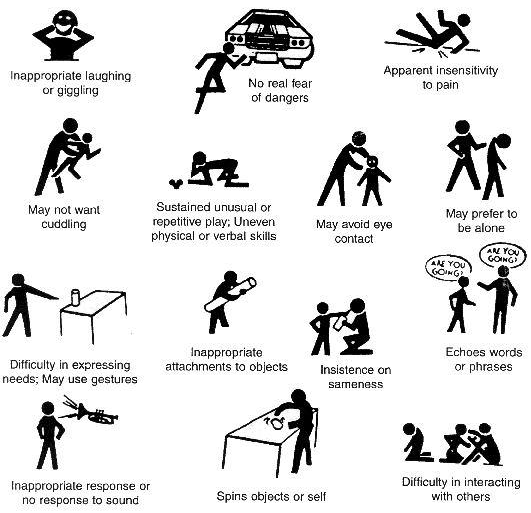
As we all know, Autism is on the rise. There can be great outcomes with early identification and early intervention. This means educating ourselves as parents and educators on what to look for, so that we can detect it as early as possible. This is a great break down on some signs that may suggest more problems. The greatest is a lack in social interaction. If you have any concerns about your child, please talk to a doctor just so that you can rule out any significant issues.

Warning Signs

Autism Warning Signs


Related Articles to ‘Autism Warning Signs’

Autism and Obesity: the Links in Pregnancy

Autism: Awareness is the Key to Intervention

Autism: A Brother Tells His Story

Physical and Health Impairments

Physical and Health Impairments: The Facts

Definition:

Both physical and health impairments are considered disabilities when they interfere with education and other daily living. Physical impairments include those caused by congenital abnormality impairments caused by disease and impairments from other causes. Health impairments include disease and/or chronic illness.

Causes:

With so many different conditions under the category of Physical and health impairments, there are also lots of diverse causes. C.P. and Spina Bifida can be caused by abnormal brain growth. Some other disorders are caused genetically, the result of an injury, poisoning, hormonal abnormalities, while some are still unknown.
Characteristics:

It is important to find out what is the underlying disease or disorder that causes the physical and/or health impairment in or to truly define the characteristics. Some characteristics can include adaptive equipment, limited movement, shortened endurance, and extra medical needs.

School Approach:

For children with physical and health impairments or traumatic brain injury, they might need slightly different support from the teacher. They often need an interdisciplinary team of professionals to aid in all of their special needs. For example, a student may need a physical therapist to work on their gross motor goals, an occupational therapist to work on fine motor and self-help skills, and a speech therapists to work on any difficulty with language. To help the students become more self-competent, the teachers and therapist(s) can help the child learn to take care of their own special medical needs. Although students with physical disabilities, health impairments, and traumatic brain injury may need a larger interdisciplinary team, it is important to note that, forty-five percent of students with physical and/or health impairments are educated in a regular classroom. It is important for the student’s special needs instructors or regular education teachers to account for the child’s needs and keep the environment open for wheelchairs and/or any other medical device that the child may have. It is also important to keep the child comfortable in their learning environment, so that they can focus on their education. This includes prioritizing safety and using assistive technology when possible to better accommodate the child’s needs.
Physical and Health Impairments

Related Articles to ‘Physical and Health Impairments: The Facts’

Physical Health Impairments

Music Therapy: How Music Can Work to Improve Lives